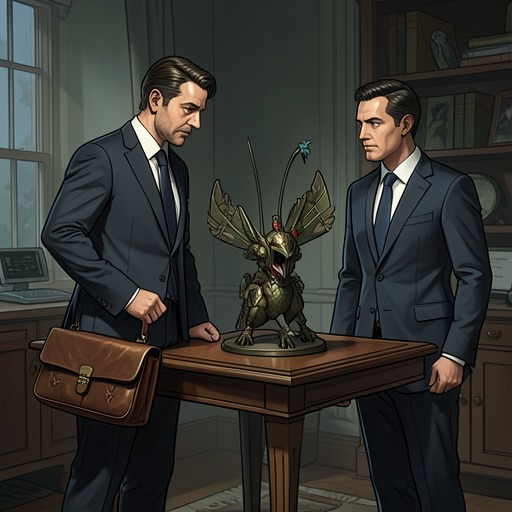
Sam Spade–Casper Gutman negotiation
The Maltese FalconThe Sam Spade–Casper Gutman negotiation is a wary business alliance in which neither man will surrender the information the other needs without securing leverage in return. Their meeting turns on the black bird’s enormous promised value, but the deeper contest is over who controls the terms of disclosure: Gutman presents himself as its uniquely informed custodian, while Spade insists that Gutman cannot proceed without him. Spade’s ultimatum converts guarded conversation into a deadline, making their relationship a compact of mutual necessity rather than trust.
The Meeting and Its Terms
Gutman’s approach begins with a telephone call to Spade’s office, arranging a meeting at twelve C and asking for it as soon as possible. When they sit down, Gutman welcomes direct talk and asks whether Spade is there as Brigid O’Shaughnessy’s representative. Spade refuses to commit himself either way. His answer is conditional: he does not yet know what the decision depends on. That uncertainty is not a casual evasion; it keeps him from being assigned to a side before he understands the available terms.
Spade then brings the discussion back to the object at issue: the black bird. Gutman asks whether Spade understands how much money can be made from it and insists that even half the sum would sound incredible. His pitch makes the falcon a commercial prize before it becomes a subject of shared knowledge. He also signals that he values a counterpart who admits to looking out for himself, treating frank self-interest as more credible than professions of disinterest.
The men approach the negotiation with different pieces of information. Spade reports that Joel Cairo is willing to buy the bird for ten thousand dollars, and that Spade has told Cairo he would expect to receive that amount if he turned it over. Gutman responds with scorn at the price. He claims that nobody besides himself knows for certain what the bird is, then immediately qualifies his disclosure by saying he may not tell Spade. Spade, in turn, asserts that he knows where it is but does not answer when Gutman asks for the location. Each has something the other wants; neither treats disclosure as an act of goodwill.
Leverage, Distrust, and the Ultimatum
Gutman calls the exchange inequitable: he says he must tell Spade what he knows, while Spade will not tell him what he knows. Spade rejects that framing and changes the balance of the meeting. He says Gutman already knows what the bird is and that Spade knows where it is, so their presence together follows from mutual need. The claim is strategic as well as informational: Spade presents his knowledge of the bird’s location as a reason Gutman must deal with him, even as he withholds the detail Gutman requests.
The discussion then hardens into an explicit threat of exclusion. Spade says he has already warned Gutman’s young associate that Gutman will have to talk to him before the business is finished. He now gives Gutman until five-thirty to decide whether he is in or out, insisting that the decision must be made that day. After his angry speech, Spade throws his glass onto the table; it breaks, scattering its contents and fragments. Gutman maintains his composed manner, while his associate remains present and silent. The break in the glass marks the scene’s shift from a measured exchange into an ultimatum, but it does not produce an immediate agreement.
Spade reinforces the deadline as he leaves: at five-thirty, the curtain will fall. The phrase makes the meeting resemble a performance with a fixed closing time, while also making clear that Gutman’s access to Spade’s help is not open-ended. The scene leaves the negotiation unresolved, but establishes the terms on which it must continue: Gutman must choose whether to cooperate, and Spade will not wait indefinitely.
The Wider Network Behind the Bargain
The negotiation takes place within a chain of alliances and betrayals over the falcon. Brigid tells Spade that she met Floyd Thursby in the Orient and came with him from Hong Kong, saying that he had promised to help her but then betrayed her while she depended on him. Later, she explains that she had helped Gutman’s group try to obtain the bird from a Russian named Kemidov. These accounts make her a link between the competing parties, but they do not give Spade a complete explanation of how the falcon was to be acquired.
Gutman’s account of Thursby further clarifies the stakes behind the conflict. Gutman says that Thursby was Brigid’s ally and a notorious killer, and that Gutman’s group expected his removal to leave her without a powerful protector and to encourage her to settle her differences with them. Gutman says they did not think Thursby possessed the falcon. They had not known that Brigid had given it to Captain Jacobi in Hong Kong to be brought across aboard the La Paloma while she and Thursby took a faster boat. Gutman says that, even when only one of the pair could have known where the bird was, he did not believe Thursby was that person.
Gutman also describes an unsuccessful attempt to win Thursby over before his death. He says that Wilmer Cook had located Thursby and tried to follow him to Brigid, but could not discover where they met. Gutman says Wilmer brought Thursby to him after waiting outside Thursby’s hotel, but Thursby remained loyal to Brigid and rejected their efforts. According to Gutman, Wilmer then followed Thursby back to the hotel and killed him. This account presents violence as part of the bargaining environment: the parties pursue information and control not only through negotiation but through surveillance, recruitment, and murder.
The Falcon’s Passage and the Cost of Information
The route of the falcon gives the negotiation its practical urgency. Gutman says Brigid entrusted it to Captain Jacobi in Hong Kong for transport on the La Paloma. Spade later reconstructs that Brigid reached the ship shortly after noon, asked for Jacobi by name, waited until he returned at four, and spent time with him in his cabin. Gutman, Joel Cairo, and Wilmer then joined Brigid there. Spade’s account of what followed describes a dispute in the cabin, a shot, and the group leaving together around midnight; he also notes that Jacobi subsequently failed to keep a meeting with shipping agents and could not be found after a fire aboard the ship.
Gutman gives a further account of the effort to recover the bird after it had moved toward Spade. He says his group found Brigid’s apartment and heard movement inside. When they identified themselves at the door, they heard a window open. Wilmer went around to cover the fire escape and encountered Jacobi in the alley, carrying the falcon. Gutman says Wilmer shot Jacobi more than once, but Jacobi continued on with the bird and knocked Wilmer down. Wilmer abandoned the pursuit when he saw a policeman approaching.
According to Gutman, Brigid then told them that Jacobi was taking the falcon to Spade’s office. Gutman says the group persuaded her to telephone Spade in an effort to draw him away before Jacobi arrived, and sent Wilmer after the captain. The episode exposes the distance between the men’s polished talk and the methods that sustain their bargaining position: the falcon changes hands through concealment and pursuit, while the men’s access to one another depends on partial reports and contested information.
Meaning and Limits of the Relationship
Spade and Gutman recognize each other as commercially minded operators, but that recognition does not amount to confidence. Gutman admires Spade’s refusal to pretend that he is not looking after his own interests; Spade, meanwhile, refuses to take Gutman’s claim to exclusive knowledge on trust. Their frankness is tactical. Each man uses candor to establish credibility while holding back the decisive fact the other seeks.
The negotiation therefore does not settle who owns the bird or what it is; it establishes who may control the next move. Gutman has the explanation he promises to disclose, while Spade claims to have the falcon’s location and imposes a deadline on the man who wants it. The relationship’s defining feature is reciprocal dependence under pressure: the prospect of profit draws them together, but every exchange is shadowed by the possibility that the other party will withhold, deceive, or use force. The five-thirty ultimatum gives that unstable arrangement a concrete form, turning a conversation about the black bird into a test of whether either man can make the other act on his terms.